

If buying a home has been on your mind throughout 2026, you’ve probably been following South Africa’s interest rate announcements. Perhaps you’ve been waiting for interest rates to drop, wondering whether you qualify for a home loan, or calculating what your monthly bond repayments might be.
Interest rates affect both those looking for homes for sale, and existing homeowners. As we look towards 2027, understanding what happened this year can help you make informed decisions about your next property purchase.
Interest Rates and How They Affect Your Monthly Bond Repayments
Throughout 2026, the South African Reserve Bank (SARB) adjusted interest rates in response to inflation and changing economic conditions. At its final announcement for 2026 on 19 November, the SARB kept interest rates unchanged, leaving the repo rate at 7.25% and the prime lending rate at 10.75%. This means the prime lending rate ended 2026 half a percentage point higher than it started.
These changes directly affect borrowing costs. The repo rate influences the prime lending rate, which banks use as a benchmark for many bonds. When interest rates rise, monthly repayments on variable-rate bonds generally increase. When they fall, repayments generally decrease.Prospective homebuyers should therefore plan around current borrowing costs rather than depend on future rate cuts.
For example, on a R900,000 home loan over 20 years, monthly repayments at 10.25% would be approximately R8,835. At 10.75%, the repayment increases to around R9,137. That’s an additional R302 per month or R3,624 annually.
For both first-time homebuyers and existing homeowners, this difference matters when balancing bond repayments with everyday household expenses. The actual interest rate offered by a bank will depend on your income, credit profile, affordability and individual lending assessment.
Should You Wait for Lower Interest Rates Before Buying?
Lower interest rates make borrowing more affordable but waiting for the perfect rate isn’t always the best approach. Interest rate forecasts can change, property prices may increase and your dream home may become unavailable while you wait.
If you take out a variable-rate home loan, you can also benefit from future interest rate reductions, even if you purchased your property when rates were higher.
What matters most is your financial readiness. Can you comfortably afford the monthly bond repayment? Is your income stable, your debt manageable and your budget flexible enough to accommodate possible rate increases?
Rather than trying to predict the lowest interest rate, focus on buying a home you can afford over the long term.
Planning for 2027: What Can Buyers Learn from 2026?
One of the biggest lessons from 2026 is that interest rates don’t always move as expected. Although earlier forecasts suggested gradual reductions, renewed inflation pressures changed the outlook.
Following November’s decision to hold interest rates steady, attention now turns to 2027. While the Reserve Bank’s projections suggest that interest rates could ease as inflation moves towards its 3% target, the timing and extent of any reductions remain uncertain.
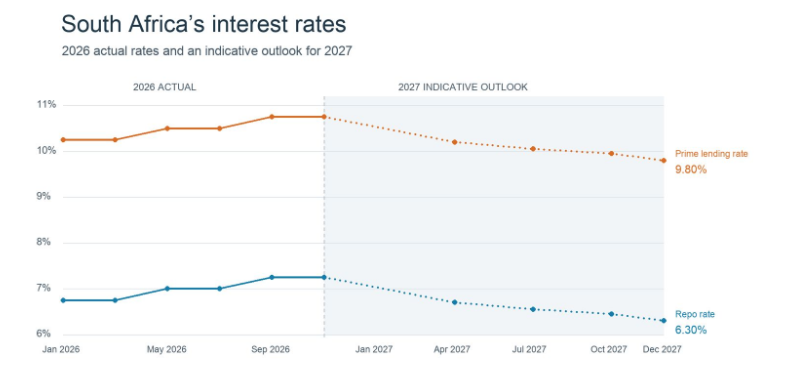
Graph created by AI using data and projections from the South African Reserve Bank (SARB).
South Africa’s repo and prime lending rates in 2026, with an indicative outlook for 2027. Dotted lines represent projections, not confirmed future interest rate decisions. Prospective homebuyers should therefore plan around current borrowing costs rather than depend on future rate cuts.
If you’re hoping to buy a home in 2027, here are four practical steps to take:
- Understand your affordability. Use a bond calculator to estimate repayments and assess how possible interest rate increases could affect your budget.
- Improve your credit profile. Pay accounts on time, reduce unnecessary debt and avoid new financial commitments.
- Get an affordability assessment. Find out what you may qualify for before beginning your property search.
- Budget beyond your bond. Allow for municipal rates, utilities, insurance, maintenance and other homeownership expenses.
For first-time homebuyers in South Africa, exploring newly built, off-plan homes can also provide a viable alternative to purchasing an existing property.
How Homes For All Helps Make Homeownership Simpler
At Homes For All, we understand that buying a home is a major financial commitment and we aim to make the process as straightforward as possible.
One advantage of our residential developments is that they are bank pre-approved. This means that the main participating banks have already assessed and approved important aspects of the development, including property values, specifications and overall viability.
This groundwork can help streamline the bond process. Buying directly from a developer can also help avoid delays associated with an existing owner’s circumstances or the need for an additional bank valuation, which may carry an extra cost for the buyer.
Individual buyers must still qualify for bond approval, but the agents working with Homes For All help make the process easier by connecting buyers with trusted bond originators for affordability assessments and guidance on financing options.
Our developments include modern, full-title homes at Sandwood Estate in Theresapark, Akasia and Paperbark Estate in Annlin, Pretoria North, alongside new homes in Midrand and other parts of Gauteng.
Whether you’re a first-time buyer or looking for a larger family home, our team can help you explore available properties suited to your needs and budget.
Make 2027 the Year You Take the Next Step
If 2026 taught us anything, it’s that interest rates can change but good financial planning remains essential. You can’t control interest rates but you can understand your affordability, prepare your finances and make informed decisions about buying a home.
If homeownership is one of your goals for 2027, Homes For All is here to help. Contact Homes For All today to explore our affordable, quality-built homes and take the next step towards homeownership.
Disclaimer: This article is intended for general information purposes only and does not constitute financial advice. Interest rates and forecasts are subject to change, and individual home loan terms and affordability will vary. Prospective buyers should consult a qualified financial adviser or bond originator before making property-related financial decisions.
If you’re ready to take the next step, have a look at Homes For All and buy a home off-plan across our property developments. You might find Paperbark Estate a secure and modern starting point, while Blue Vista offers great entry-level homes. Presidents Place stands out for its convenient location and spacious layouts.
These – and all our other property developments – aim to make the dream of owning a home more accessible. Exploring these sites could be the first move towards finding a home that comfortably suits your budget and your family’s future.
Speak to a member of our team to find out more.
Email: sales@homesforall.co.za
Facebook – https://www.facebook.com/Homesforalll/
Instagram – https://shrturl.app/U5gWJT
WhatsApp – +27 82 721 2570
Homes For All holds a Fidelity Fund Certificate issued by the Property Practitioners Regulatory Authority (PPRA)
Author: Twaambo Chirwa
